


en
en v
Phone
Cart0 Tickets
Total: 0
Account
Calendar
Search
Menu
X

Onegin

VenuePrague National Theatre
CalendarSat 14 Nov 2026 - Sat 19 Jun 2027
Synopsis/Details


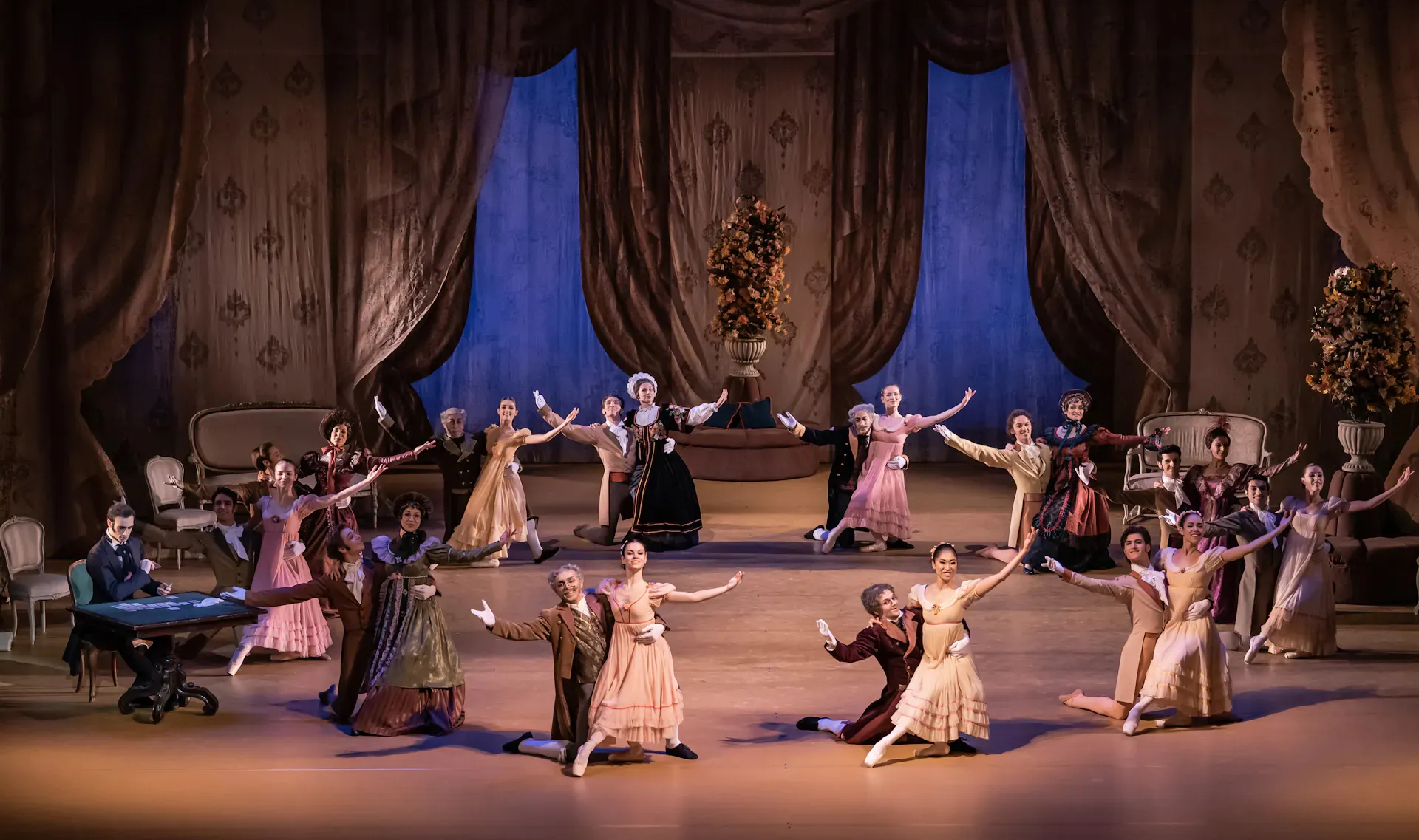
The production, which will premiere at the National Theatre, requires from the performers expressive acting, brilliant dance technique and a profound sense for a range of emotional portrayal of the individual characters.

Cranko’s Onegin, to be staged at the National Theatre, requires from the dancers expressive acting, brilliant technique and profound sense for conveying the characters’ emotions and feelings. Alexander Pushkin’s novel in verse Eugene Onegin,a classic of Russian literature, enjoys worldwide fame and popularity. It depicts the story of hapless love between Onegin, a St Petersburg dandy, and Tatyana, the bashful daughter of a landowner. Cranko created his version for the Stuttgarter Ballett, who premiered it in 1965, with Márcia Haydée and Ray Barra in the lead roles. Pushkin’s heroes first appeared on stage owing to Pyotr Ilyich Tchaikovsky, who based his 1878 opera Eugene Onegin on the novel. Cranko, however, set his ballet to a compilation of other Tchaikovsky pieces, arranged by Kurt-Heinz Stolze.

A treasure of the global ballet legacy, Cranko’s Onegin has been a staple of the repertoire of theatres all over the world. The production’s overall visual concept induces the atmosphere of Pushkin’s novel, with Elisabeth Dalton’s costumes amplifying the romantic hallmark.

The Czech National Ballet soloists and corps de ballet
National Theatre Orchestra

Photo of the visual image: Younsik Kim

WARNING: Gunshots will be heard during the performance.
Suitable for audience from 12 years.


Synopsis

Time: The 1820s

Place: St Petersburg and surrounding countryside
Act 1

Scene 1: The garden of the Larin country estate

Madame Larina and the nurse Filippyevna are sitting outside in the garden. They can hear Madame Larina's two daughters, Tatyana and her younger sister Olga, singing a love song. Madame Larina begins to reminisce about her own courtship and marriage. A group of peasants enter, and celebrate the harvest with songs and dances. Tatyana and Olga watch. Tatyana has been reading a romantic novel and is absorbed by the story; her carefree sister, on the other hand, wants to join in the celebrations. Madame Larina tells Tatyana that real life is very different from her novels. Filippyevna announces that visitors have arrived: Olga's fiancé Lensky, a young poet, and his friend Eugene Onegin, visiting the area from St Petersburg. The pair are shown in and Lensky introduces Onegin to the Larin family. Onegin is initially surprised that Lensky has chosen the extrovert Olga rather than her more subtle elder sister as his fiancée. Tatyana for her part is immediately and strongly attracted to Onegin. Lensky expresses his delight at seeing Olga and she responds flirtatiously. Onegin tells Tatyana of his boredom in the country and describes the death of his uncle and his subsequent inheritance of a nearby estate. Filippyevna recognizes that Onegin has had a profound effect on Tatyana.

Scene 2: Tatyana's room

Tatyana is dressed for bed. Restless and unable to sleep, she asks her nurse Filippyevna to tell her about her youth and early marriage. Tatyana confesses that she is in love. Left alone, Tatyana pours out her feelings in a letter to Onegin. She tells him that she loves him and believes that she will never feel this way about anyone else, and begs him to understand and help her. She finishes writing the letter at dawn. A shepherd's pipe is heard in the distance. Filippyevna enters the room to wake Tatyana. Tatyana persuades her to send her grandson to deliver the letter to Onegin.

Scene 3: Another part of the estate

Servant girls pick fruit and sing as they work. Tatyana waits anxiously for Onegin's arrival. Onegin enters to see Tatyana and give her his answer to her letter. He explains, not unkindly, that he is not a man who loves easily and is unsuited to marriage. He is unworthy of her love and can only offer her brotherly affection. He warns Tatyana to be less emotionally open in the future. The voices of the servant girls singing are heard again. Tatyana is crushed and unable to reply.
 

Act 2

Scene 1: The ballroom of the Larin house

A ball is being given in honour of Tatyana, whose name day it is. Onegin is dancing with her. He grows irritated with a group of neighbours who gossip about him and Tatyana, and with Lensky for persuading him to come to the ball. He decides to avenge himself by dancing and flirting with Olga. Lensky is astounded and becomes extremely jealous. He confronts Olga but she cannot see that she has done anything wrong and tells Lensky not to be ridiculous. Onegin asks Olga to dance with him again and she agrees, as "punishment" for Lensky's jealousy. The elderly French tutor Monsieur Triquet sings some couplets in honour of Tatyana, after which the quarrel between Lensky and Onegin becomes more intense. Lensky renounces his friendship with Onegin in front of all the guests, and challenges Onegin to a duel, which the latter is forced, with many misgivings, to accept. Tatyana collapses and the ball ends in confusion.

Scene 2: On the banks of a wooded stream, early morning

Lensky is waiting for Onegin with his second Zaretsky. Lensky reflects on his life, his fear of death and his love for Olga. Onegin arrives with his manservant Guillot. Both Lensky and Onegin are reluctant to go ahead with the duel, reflecting on the senselessness of their sudden enmity. But it is too late; neither man has the courage to stop the duel. Zaretsky gives them the signal and Onegin shoots Lensky dead.
 

Act 3

Scene 1: The house of a rich nobleman in St Petersburg

Years have passed, during which Onegin has travelled extensively around Europe. Standing alone at a ball, he reflects on the emptiness of his life and his remorse over the death of Lensky. Prince Gremin enters with Tatyana, his wife, now a grand, aristocratic beauty. She is greeted by many of the guests with great deference. Onegin is taken aback when he sees Tatyana, and deeply impressed by her beauty and noble bearing. Tatyana, in turn, is overwhelmed with emotion when she recognizes him. Gremin tells Onegin about his great happiness and love for Tatyana, and re-introduces Onegin to his wife. Onegin, suddenly injected with new life, realizes that he is in love with Tatyana. He determines to write to her and arrange a meeting.

Scene 2: A room in Prince Gremin's house

Tatyana has received Onegin's letter, which has stirred up the passion she felt for him as a young girl and disturbed her. Onegin enters. Tatyana recalls her earlier feelings and asks why Onegin is pursuing her now. Is it because of her social position? Onegin denies any cynical motivation: his passion is real and overwhelming. Tatyana, moved to tears, reflects how near they once were to happiness but nevertheless asks him to leave. He asks her to have pity. Tatyana admits she still loves Onegin, but asserts that their union can never be realized, as she is now married, and determined to remain faithful to her husband despite her true feelings. Onegin implores her to relent, but she bids him farewell forever, leaving him alone and in despair.

Approximate running time: 2 hours 10 minutes, 2 intermission (20 minutes)

Premiere: February 20, 2020


The Czech National Ballet has reincorporated into its repertoire Onegin, a true gem among narrative ballets, as choreographed by John Cranko, a major 20th-century dance figure and illustrious storyteller. The piece is another addition to the influential artist’s works the company has performed in recent years (Swan Lake, Romeo and Juliet).

Cast

Creatives

Choreography: John Cranko

Music: Kurt-Heinz Stolze; after Pyotr Ilyich Tchaikovsky

Sets and costumes: Elisabeth Dalton

Lighting design and Visual supervisor: Steen Bjarke

Costume supervision: Diana Eckmann

Staged by: Jane BourneFilip Barankiewicz

Artistic supervision: Reid Anderson

Musical preparation: Václav Zahradník

Venue
Prague National Theatre

The National Theatre today


The historical building of the National Theatre, constructed in 1883, is generally considered the prime stage in the CzechRepublic. It is the flagship of the National Theatre institution, today amounting to five buildings and encompassing four companies. You can see there Opera, Drama and Ballet performances.


Practical information


Where to buy tickets

When purchasing tickets online, you will receive an e-ticket, which does not need to be printed—you can simply present it on your device upon entry. When available, you may also choose to collect printed tickets from the National Theatre box offices, and any tickets purchased directly at the box office will be issued in physical form.

The National Theatre sells tickets up to 6 months in advance.
Sales always start on the 1st day of the month at 9am, except in January when pre-sales do not start until the 2nd day due to a public holiday.


When do the doors open prior the show?

The National Theatre, The State Opera and the Estates Theatre are open 45 minutes prior the performance in time of increased hygiene practices. The evening box offices are open at the same time.

The main box office at the New Stage on play days is open until the beginning of the show. The New Stage auditorium is open 30 minutes prior the performance.


What kind of dress is suitable for attending the theatre?

Dress codes are only required for special events. By their appearance, the visitors indicate that they are aware of the festive occasion they are experiencing at the theatre. Persons in markedly soiled clothes and persons whose behaviour may compromise the safety of the other visitors are not allowed to enter the respective premises, or can be ejected from them.


Where do I park?

While visiting the National Theatre and the New Stage, you are welcome to use the underground National Theatre car park (access from Ostrovní Street). Please note that the parking is subject to a fee.
Only non-cash payments: Parking fees can be paid exclusively by cashless payment card or another virtual device (watch or phone). Thank you for your understanding


Buffets at the State Opera

No waiting. For your benefit, please pre-order your food and beverages at the bar to minimize waiting in the queue!


Accessibility for the disabled

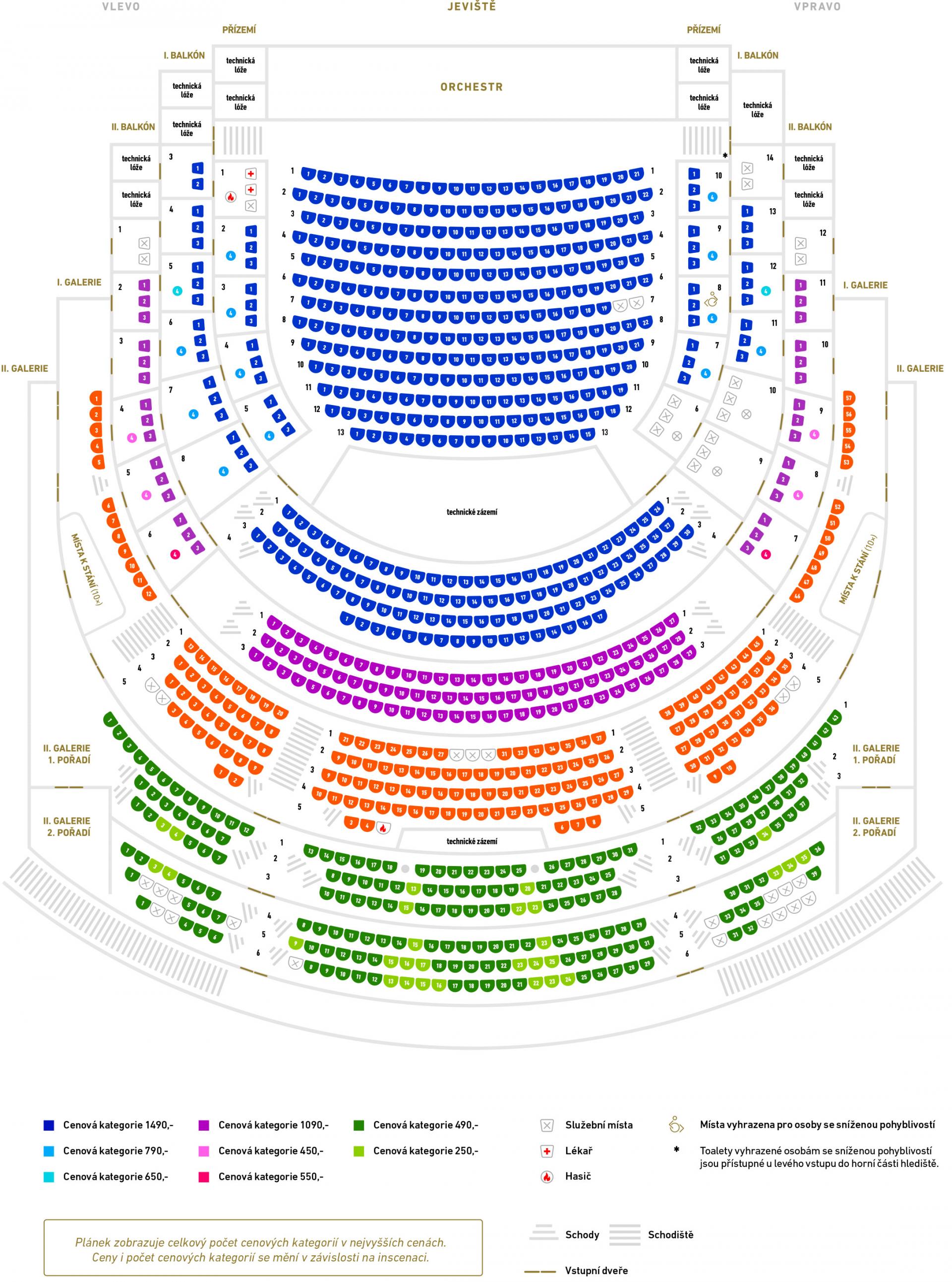
All the National Theatre venues are accessible to disabled persons, with special seats allocated for them in the auditorium. It is, however, advisable to consult each visit in advance with the National Theatre Sales Department.


Can I get an artist’s signature? Can I leave them flowers?

The National Theatre does not provide signatures of artists or contacts to them. You can leave flowers for artists performing in the show before its beginning at the theatre stuff.


Idea of building a stately theatre for the Czech nation


The National Theatre is the embodiment of the will of the Czech nation for a national identity and independence. Collections of money among the broad mass of the people facilitated its construction and hence the ceremonial laying of its foundation stone on 16 May 1868 was tantamount a nationwide political manifestation.


The idea of building a stately edifice to serve as a theatre was first mooted in the autumn of 1844 at meetings of patriots in Prague. It began to materialise through a request for “the privilege of constructing, furnishing, maintaining and managing” an independent Czech theatre, which was submitted to the Provincial Committee of the Czech Assembly by František Palacký on 29 January 1845. The privilege was granted in April 1845. Yet it was not until six years later – in April 1851 – that the Society for the Establishment of a Czech National Theatre in Prague (founded in the meantime) made its first public appeal to start collections. A year later the proceeds of the first collections allowed for the purchase of land belonging to a former salt works with the area of less than 28 acres, which predetermined the magnificent location of the theatre on the bank of the river Vltava facing the panorama of Prague Castle, yet at the same time the cramped area and trapezoidal shape posed challenging problems for the building’s designers.


By tram

By daytime trams Nos. 6, 9, 18 and 22 and night trams Nos. 53, 57, 58, 59 to the stop “Národní divadlo” – in front of the NT historical building; by daytime tram No. 17 to the stop “Národní divadlo”.


By metro

To the station “Můstek”, line B (yellow), and then by foot on Národní street; or to the station “Karlovo náměstí” and then two stops by tram No. 6, 18 or 22 to the stop “Národní divadlo”. To the station “Staroměstská”, line A (green), and then two stops by tram No. 17 to the stop “Národní divadlo”. 

Accomodation

Buy now

Gift vouchers

Gift someone an unforgettable night at the opera.
Choose a gift coupon and let them pick the performance they love—music, drama, and world-class artistry, all in one elegant experience.
Prague Opera Tickets
Facebook
Payment
Ticket search
Google Play
App Store
© 2026 RM EUROPA TICKET GmbH
Whatsapp