Tomáš Netopil and stars of the New York Met in the dramatic and entertaining legend based on Goethe’s Faust. All roads lead to hell!
Faust:
Who are you, whose burning look
Penetrates like the flash of a dagger,
And who, like flame,
Burns and devours the soul?
Mephistopheles:
Truly for a doctor that is a frivolous question.
I am the Spirit of Life, and it is I that console.
I will give you everything, happiness, pleasure,
All that the most ardent desire can dream of.
Faust:
Very well, poor demon, show me your wonders.
“This marvellous book fascinated me from the very beginning. I could not put it down. I read it incessantly, during meals, in the theatre, in the street, everywhere,” composer Hector Berlioz, musical visionary of 19th century French music, and perhaps something of a fantasist, describes his enchantment with Goethe’s Faust. His “Faustian” passion gave rise initially to Eight Scenes from Faust and then, eighteen years later, to a composition perhaps even more remarkable than his Symphonie fantastique – a “légende dramatique” that treads a fine line between oratorio and opera entitled La Damnation de Faust (The Damnation of Faust). Here, Berlioz’s version of the story deviates considerably from Goethe’s play, with the composer mercilessly propelling the protagonist to the gates of hell right from the start. However, before he condemns Faust forever, Berlioz applies his special brand of imagination as he takes him on numerous adventures full of twists and turns involving a series of entertaining, dramatic and, naturally, also romantic scenes. Tomáš Netopil chose this extraordinary work for mixed and children’s choirs, four soloists and large orchestra for his debut at the Prague Spring as the new Chief Conductor of the Prague Symphony Orchestra. The main roles of Faust and Mephistopheles will be undertaken by stars of the Metropolitan Opera in New York, tenor Paul Appleby and bass Alexander Vinogradov, Marguerite will be sung by soloist at the Semperoper Dresden Štěpánka Pučálková, and the role of the student Brander will be performed by Pavel Švingr, soloist at the National Theatre Opera and State Opera.
During his time Hector Berlioz (1803–1869) was acknowledged to a far greater extent as a conductor and as an original music critic. As a composer he was ahead of his time by several decades, and so many of his revolutionary musical ideas were misunderstood during his lifetime, only to be picked up by composers of the younger generation, such as Richard Wagner. Likewise the Paris premiere of The Damnation of Faust in 1846 was a total fiasco. It wasn’t until fifty years later that this monumental work finally triumphed, when it was staged at the Opéra de Monte-Carlo in 1893. As mentioned above, Berlioz did not seek to duplicate the story of Goethe’s Faust, stating in his foreword: “The very title of the work indicates that it is not based on the principal idea of Goethe, since, in his great poem, Faust is saved.” Berlioz was essentially interested in the “musical essence” of Faust, from which he extracted the maximum. The composition, lasting over two hours, brims with imitative elements, explicit tone colour and wit; for example, in the Pandemonium chorus in Part IV, when a group of damned souls emit menacing gibberish, or in the scene in the wine cellar, when the student Brander sings a song about a dead rat, which culminates in a blasphemous, flawless choral fugue written to the text of the devotional Amen. Adding some of his own ideas, the composer compiled the French libretto himself, working with the French translation of Faust by Gérard de Nerval. “Once underway, I wrote the missing verses as the musical ideas came to me. I composed the score when and where I could – in the carriage, on the train, on steamboats.” Conductor Tomáš Netopil told us: “For me, La Damnation de Faust is not only a musical feast but also an adventure. The fantastical world of Hector Berlioz’s innovative musical aesthetic brings an originality which propels this dramatic tale towards an extremely credible and intensive musical and dramatic experience, where the Faustian theme once again becomes a familiar human story.”
 en
en 
 de
de it
it fr
fr es
es ru
ru jp
jp ro
ro








 Municipal House Theater Prague
 Mon 25 May 2026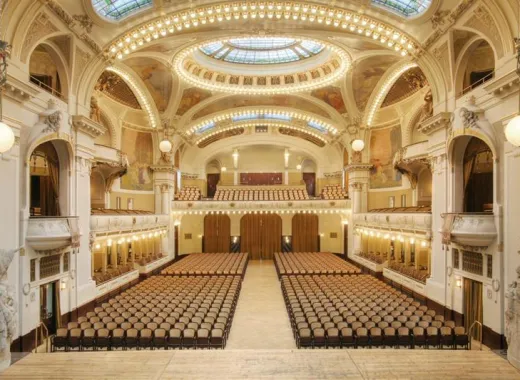



 RM EUROPA TICKET GmbH
 Call now
 Book now