
 EN
EN DE
DE IT
IT FR
FR ES
ES RU
RU JP
JP RO
RO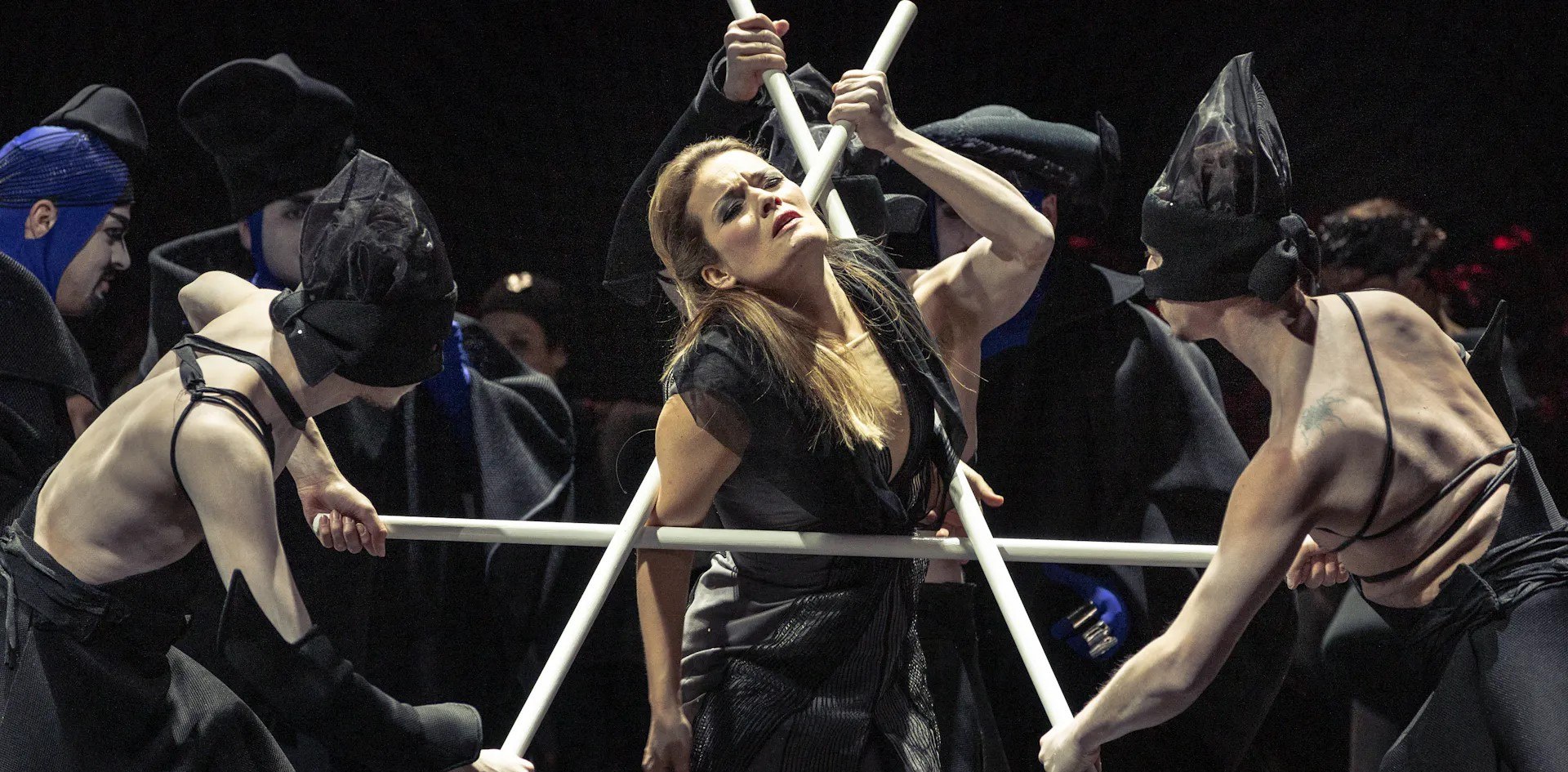
© Patrik Borecký
Turandot
Order tickets
 October 2026 October 2026  | ||||||
|---|---|---|---|---|---|---|
Mo | Tu | We | Th | Fr | Sa | Su |
Turandot – Giacomo Puccini | Opera
Approximate running time: 2 hours 45 minutes, including two 20-minute intermissions
Language: Italian, with surtitles in Czech and English
Giacomo Puccini’s final opera, Turandot, may be deemed to be the “last of the Mohicans” of the Golden Age of Italian Romantic opera. The greatest of Verdi’s heirs, the composer, however, did not get bogged down in this tradition, but went on to boldly develop and enrich it with the flavours of the new artistic styles that emerged in the late 19th and the early 20th centuries. Consequently, his Turandot, written between and 1921 and 1924, does not feature many Romantic traits.
Puccini based the opera on the eponymous commedia dell’arte play by Carlo Gozzi, an author much admired by the early 20th-century avant-garde artists. The subject hails from Persia or Mongolia, whose cultures were mainly marvelled at by votaries of the decorative style, while the libretto’s story is set in medieval Beijing and foregrounds fairy-tale, or better said mythological, elements, favoured by the Symbolists. The theme of passionate love, essential for Romantic opera, is veiled in mysterious motifs of ice, fire, moon, while an erotic flame enigmatically blazes along with intense, unrelenting hatred, which we would rather expect to be present in works inspired by decadence or psychoanalysis.
Yet all that which, notwithstanding its modernism, gives Turandot the Romantic opera hallmark is Puccini’s musical idiom, which too encompasses plenty of “eccentric” facets – ranging from Oriental paraphrases, through a brutal orchestral sound, dissonant harmonies to wildly complex chorus and ensemble scenes – but what prevails is Puccini’s masterful melodic invention in the spirit of the legacy of his great Italian opera predecessors, yet utterly original – by and large, Puccinian.
Suitable for audience from 12 years.
Synopsis
Act One
On the ramparts of Peking, an official announces the Emperor’s decree: the beautiful Princess Turandot will only marry a suitor who answers the three riddles she will ask. Yet whoever takes the test and fails will be beheaded, just like the Prince of Persia, who has been sentenced to death. Amid the throng eagerly awaiting the execution, Prince Calaf sees his long-lost father, Timur, the King of Tartary, and his companion, the slave-girl Liù. All of them fled their country after it was conquered by enemies and now live discreetly among the common people. Upon the moonrise, the doomed Prince of Persia is led to the scaffold. Then Turandot herself appears. Enthralled by her beauty, and notwithstanding the threats and danger, Calaf decides to undergo the test with a view to marrying the Princess. Timur and Liù beg him to leave Peking with them, yet to no avail. Nor do the imperial ministers Ping, Pang and Pong succeed in changing his mind. Calaf is driven by insatiable desire, as well as by the mysterious voices of the dead suitors of the cruel Princess. He strikes the gong three times, thus declaring his determination to face Turandot and take the test.
Act Two
Scene 1
Ping, Pang and Pong ponder whether Turandot’s new suitor will join the numerous victims of her brutality or whether he will win and marry her. They lament that owing to the haughty Princess their ministerial duties have been reduced to assisting the executioner. The three men recall their cosy residences in the countryside, where they would like to return. They speculate as to what it would be like if Turandot ceased to scorn love and finally took a husband, concluding that peace and serenity would reign in the whole of China ... Yet the ministers’ idyll is disturbed by the commotion in the imperial palace, which is getting ready for the test Calaf is to undergo.
Scene 2
At a grand assembly in the palace courtyard, Emperor Altoum himself urges Calaf to withdraw his challenge and forgo his intention to woo Turandot, adding that he would only enlarge the number of the victims of his daughter’s heartlessness, as the riddles are simply irresolvable. Yet Calaf does not yield and persists in his decision. Turandot arrives and gives a solemn speech, describing the reason why she hates men – she has been taking revenge on behalf of her ancestress, Princess Lou-Ling, who during an invasion of China was dragged off by a foreigner to his country, where she would later perish. Subsequently, Turandot presents her riddles, to which Calaf gives the correct answers: “hope”, “blood” and, finally, “Turandot”. Refusing to accept defeat, she beseeches her father not to give her to the foreigner. The Emperor is unflinching, therefore Calaf comes up with a suggestion of his own. He wants Turandot to fall in love, not to suffer in detested arms, and so he himself asks the Princess a riddle: she should guess his still unknown name correctly – if she does so by dawn, he is willing to renounce his victory and die at the executioner’s hand. Turandot duly accepts.
Act Three
Scene 1
Upon pain of death, no one in Peking is allowed to sleep and keep the foreign Prince’s name secret. Turandot is determined to find out the name even if it entails torturing and murdering of citizens. Headed by the ministers Ping, Pang and Pong, a delegation approaches Calaf and implores him to either forget about Turandot and leave, or reveal his name. The Prince rejects the beautiful girls and wealth he is offered in return, awaiting the sunrise that will decide his and Turandot’s fate. The guards bring Timur and Liù, who were seen talking with Calaf and thus it is presumed that they know his name. Liù steps forward, claiming that she does indeed know the Prince’s name, but will never disclose it. Turandot appears and lets the furious crowd and the guards wrest the name from Liù by force. When the tortured Liù continues to refuse to speak, Turandot asks her what has given her the strength to defy so mightily. The slave-girl answers that she is emboldened by love for the Prince – she has secretly loved him for a very long time, and now she will sacrifice her love for him for his love for Turandot. Should Turandot not get to know his name, Calaf will gain her hand, whereas Liù will lose him for ever. Liù foretells that Turandot too will fall in love with Calaf, then snatches a dagger from one of the soldiers and pierces her heart. The consternated throng goes on to bemoan Liù. Calaf blames Turandot for the death of the innocent girl, yet the Princess remains aloof and impassive. Calaf gives vent to his passion and desire for Turandot – although still spurning him, she ultimately finds herself in his arms and his kisses begin to soften and thaw her obstinacy. The day breaks and Turandot admits that Calaf’s desire has ignited in her love, which she has previously always resisted with might and main. Before dawn, Calaf will tell Turandot his name – even though he has won, it will be she who will decide his lot.
Scene 2
As the sun rises, Turandot appears before a gathering in the palace. The Princess approaches the Emperor and declares that she now knows the foreign Prince’s name. It is “Love”, the light of the world. The story ends with a hymn to love.
Program and cast
Conductor: Giuseppe Finzi
Turandot: Maida Hundeling
Timur: František Zahradníček
Kalaf: Denys Pivnitskyi
Liu: Alžběta Poláčková
Ping: Jiří Brückler
Pang: Jaroslav Březina
Pong: Martin Šrejma; Josef Moravec
Mandarin: Miloš Horák; Roman Vocel
Altoum: Jan Ježek
Prince of Persia: Martin Dvořák; Marek Lhotský
Stage direction and set design: Zuzana Gilhuus
Costumes: Boris Hanečka
Choreography: Martin Dvořák
Light design: Martin Bronec
Chorus master: Pavel Vaněk
Dramaturgy: Ondřej Hučín
National Theatre Chorus
National Theatre Orchestra
National Theatre Opera Ballet
Kühn Choir of Prague
Prague Philharmonic Children's Choir
Prague National Theatre
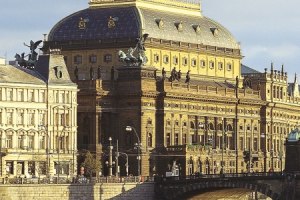
The National Theatre today
The historical building of the National Theatre, constructed in 1883, is generally considered the prime stage in the CzechRepublic. It is the flagship of the National Theatre institution, today amounting to five buildings and encompassing four companies. You can see there Opera, Drama and Ballet performances.
Practical information
Where to buy tickets
When purchasing tickets online, you will receive an e-ticket, which does not need to be printed—you can simply present it on your device upon entry. When available, you may also choose to collect printed tickets from the National Theatre box offices, and any tickets purchased directly at the box office will be issued in physical form.
The National Theatre sells tickets up to 6 months in advance.
Sales always start on the 1st day of the month at 9am, except in January when pre-sales do not start until the 2nd day due to a public holiday.
When do the doors open prior the show?
The National Theatre, The State Opera and the Estates Theatre are open 45 minutes prior the performance in time of increased hygiene practices. The evening box offices are open at the same time.
The main box office at the New Stage on play days is open until the beginning of the show. The New Stage auditorium is open 30 minutes prior the performance.
What kind of dress is suitable for attending the theatre?
Dress codes are only required for special events. By their appearance, the visitors indicate that they are aware of the festive occasion they are experiencing at the theatre. Persons in markedly soiled clothes and persons whose behaviour may compromise the safety of the other visitors are not allowed to enter the respective premises, or can be ejected from them.
Where do I park?
While visiting the National Theatre and the New Stage, you are welcome to use the underground National Theatre car park (access from Ostrovní Street). Please note that the parking is subject to a fee.
Only non-cash payments: Parking fees can be paid exclusively by cashless payment card or another virtual device (watch or phone). Thank you for your understanding
Buffets at the State Opera
No waiting. For your benefit, please pre-order your food and beverages at the bar to minimize waiting in the queue!
Accessibility for the disabled
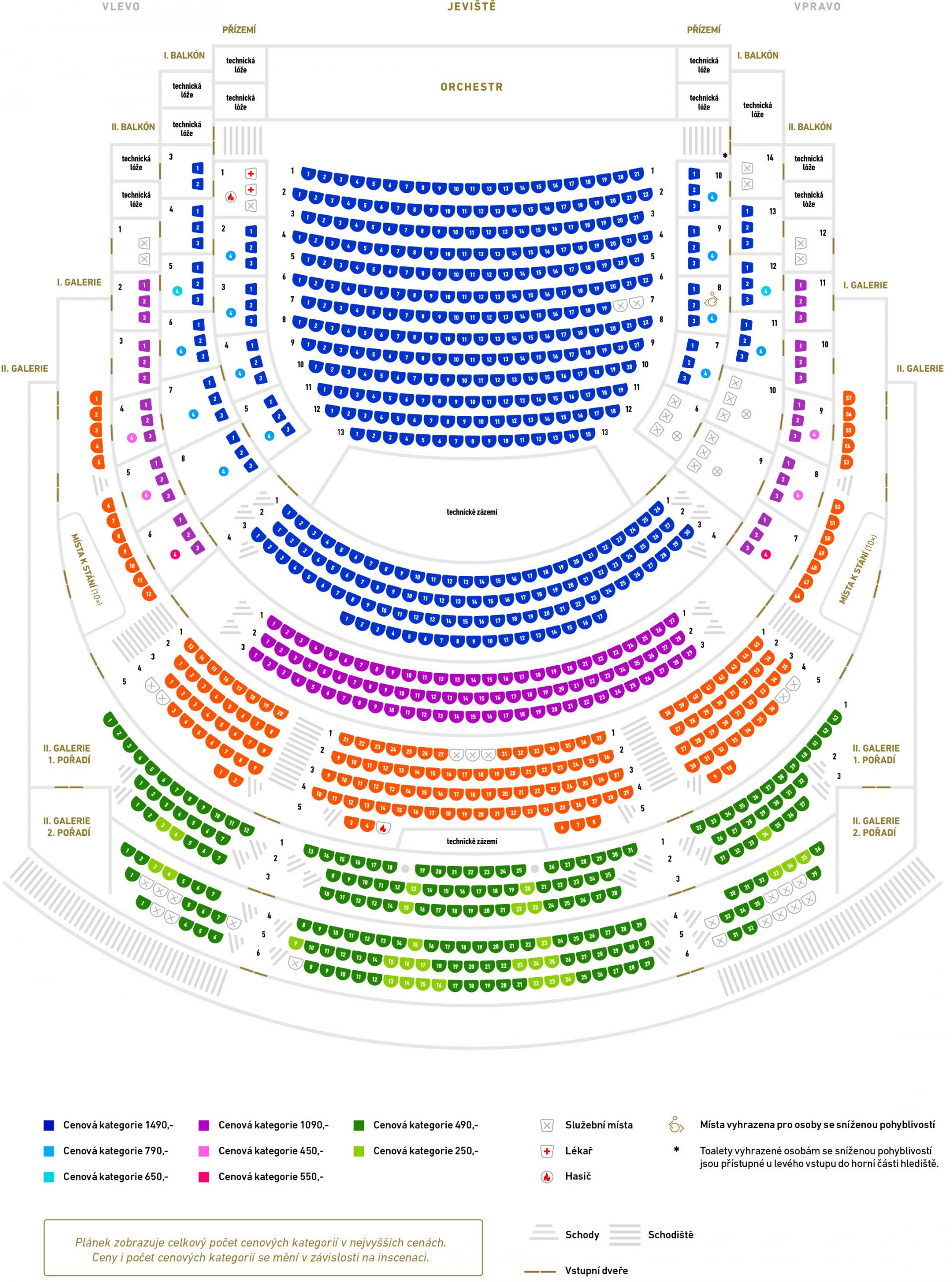
All the National Theatre venues are accessible to disabled persons, with special seats allocated for them in the auditorium. It is, however, advisable to consult each visit in advance with the National Theatre Sales Department.
Can I get an artist’s signature? Can I leave them flowers?
The National Theatre does not provide signatures of artists or contacts to them. You can leave flowers for artists performing in the show before its beginning at the theatre stuff.
Idea of building a stately theatre for the Czech nation
The National Theatre is the embodiment of the will of the Czech nation for a national identity and independence. Collections of money among the broad mass of the people facilitated its construction and hence the ceremonial laying of its foundation stone on 16 May 1868 was tantamount a nationwide political manifestation.
The idea of building a stately edifice to serve as a theatre was first mooted in the autumn of 1844 at meetings of patriots in Prague. It began to materialise through a request for “the privilege of constructing, furnishing, maintaining and managing” an independent Czech theatre, which was submitted to the Provincial Committee of the Czech Assembly by František Palacký on 29 January 1845. The privilege was granted in April 1845. Yet it was not until six years later – in April 1851 – that the Society for the Establishment of a Czech National Theatre in Prague (founded in the meantime) made its first public appeal to start collections. A year later the proceeds of the first collections allowed for the purchase of land belonging to a former salt works with the area of less than 28 acres, which predetermined the magnificent location of the theatre on the bank of the river Vltava facing the panorama of Prague Castle, yet at the same time the cramped area and trapezoidal shape posed challenging problems for the building’s designers.
By tram
By daytime trams Nos. 6, 9, 18 and 22 and night trams Nos. 53, 57, 58, 59 to the stop “Národní divadlo” – in front of the NT historical building; by daytime tram No. 17 to the stop “Národní divadlo”.
By metro
To the station “Můstek”, line B (yellow), and then by foot on Národní street; or to the station “Karlovo náměstí” and then two stops by tram No. 6, 18 or 22 to the stop “Národní divadlo”. To the station “Staroměstská”, line A (green), and then two stops by tram No. 17 to the stop “Národní divadlo”.
Related events