
 EN
EN DE
DE IT
IT FR
FR ES
ES RU
RU JP
JP RO
RO
© Ondřej Soukup © Jana Marie Knotova
Prague Spring Debut
Order tickets
May 2026 | ||||||
|---|---|---|---|---|---|---|
Mo | Tu | We | Th | Fr | Sa | Su |
The festival’s twelfth conducting debut will be caught up in a whirl of dance. Copland, Barber, Dvořák and Ginastera performed by Ondřej Soukup, soprano Simona Šaturová and Prague Philharmonia.
The Prague Spring Debut, a platform for talented young Czech conductors, has become an integral part of the festival, where the eyes of both the public and the critics are trained on the debut performance of a young artist. The twelfth debutant in the series, appearing at the festival in 2026, will be a graduate of the prestigious Royal College of Music in London and laureate of the Ionel Perlea International Conducting Competition, Ondřej Soukup. The artist, who is fast making a name for himself particularly in Great Britain and Scandinavia, will be conducting the Prague Philharmonia for the first time. The young conductor spoke to us about the programme, which focuses on the American continent: “We begin with Copland’s sound of the open American prairies, then time stands still for a while in Barber’s Knoxville. After the break certain movements in Dvořák’s Suite bring to mind Barber’s nostalgia, while others are evocative of Copland’s dance entrée. And with Ginastera we dance our way to the grand finale.” Samuel Barber’s persuasive Knoxville: Summer of 1915 was written to a text by James Agee, Pulitzer Prize-winner and friend of Charlie Chaplin. Its solo part will be performed by excellent Slovak soprano Simona Šaturová, who lent her voice to the prima donna Caterina Gabrielli in the film Il Boemo, which won a Czech Lion award, and in her own career she has appeared with the Vienna Philharmonic under Herbert Blomstedt, Staatskapelle Dresden under Manfred Honeck and the Boston Symphony Orchestra under Charles Dutoit.
Ondřej Soukup is a distinctive, young Czech conductor with a rapidly developing international career. “Ondřej has a great conducting technique, efficient rehearsal technique, along with musical and personal maturity,” declared Dutch conductor Jac van Steen, whom the young artist joined as assistant conductor of the Prague Symphony Orchestra and the National Youth Orchestra of Scotland. At the Royal College of Music he had the opportunity to work with Sir Antonio Pappano, the late Sir Roger Norrington and with Sir Thomas Allen, and he also assisted American conductor Ryan Bancroft with the BBC National Orchestra of Wales and Sweden’s Malmö Symphony Orchestra. Despite his young age he has varied experience not only with the symphonic repertoire but also with opera and choral works from different periods, from Wagner’s Das Rheingold to new compositions by young composers. At the start of 2025 he premiered the opera The Play of the Night by leading Swedish composer Britta Byström. The holder of the Roderick Brydon Memorial Award for talented young conductors, Soukup has already conducted orchestras in Denmark, Sweden, Great Britain and naturally also the Czech Republic. He has also established a composition competition and is closely involved in charity projects.
Program and cast
Programme
Aaron Copland: Four Dance Episodes from Rodeo
Samuel Barber: Knoxville: Summer of 1915
Antonín Dvořák: Suite in A major Op. 98b
Alberto Ginastera: Four Dances from Estancia Op. 8a
Performers
Prague Philharmonia
Ondřej Soukup – conductor
Simona Šaturová – soprano
Rudolfinum
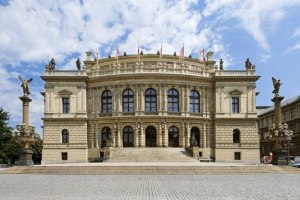
The Rudolfinum, one of the most noteworthy buildings in Prague, was built between 1876 and 1884 according to the designs of architects Josef Zítek and Josef Schulze. Originally intended as a multipurpose cultural building in Prague, the Rudolfinum was inagurated on February 7, 1885. It carried out its mission until 1919, when it was converted to the House of Commons of the Czechoslovak Republic. Concert activity was restored to the Rudolfinum during the German occupation, but full rehabilitation, particularly of the gallery, did not take place until 1992. After a general reconstruction by architect Karel Prager in 1992, the Rudolfinum became the home of the Czech Philharmonic and the Rudolfinum Gallery.
Dvorana – Ceremony Hall
The central space in the gallery portion of the Rudolfinum was designed by Josef Zítek and Josef Schulz as an entrance hall to the art gallery. After 1918, however, this space was converted into a parliamentary cafeteria, and after World War II it served as a gymnasium for the Prague Conservatory. At the end of the 1980s, Ceremony Hall was threatened with reconstruction – but plans to tear down the main staircase to make room for another concert hall did not go through, and the hall retained its original appearance. Of particular interest in Ceremony Hall are 25 empty spaces on its walls, which were originally intended to be filled in with frescos. The majority of the eminent Czech painters, however, boycotted the 1891 fresco competition in protest over the large number of German artists involved in the construction of the Rudolfinum.
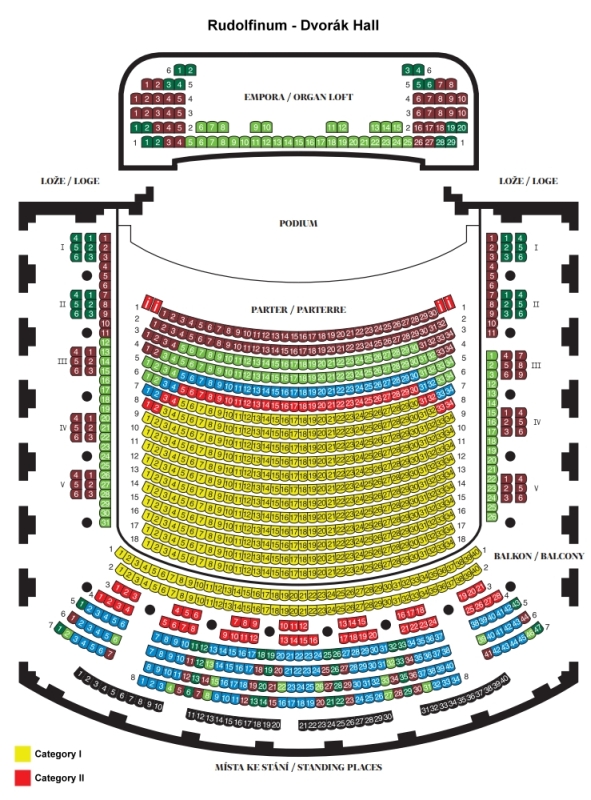
Dvořák Hall
The Czech Philharmonic took the stage in this world-famous concert hall in 1896, performing for its first-ever concert under the baton of Antonín Dvořák himself. The hall remained a space for concerts and performances until 1918, at which time it became a boardroom for the new parliament of the Czechoslovak Republic. The stage and the organ loft became a tribunal (garnished with a statue of President T.G. Masaryk), from which parliamentary leaders presided over proceedings. The hall's original character (and purpose) was restored
in 1940–1942 according to a project conceived by Antonín Engel and Bohumír Kozák, and it has remained in this form through to the present. In accordance with Josef Zítek and Josef Schulz's original proposal, the central visual element in the hall is an organ, which was made in Frankfurt, Germany. During the hall's stint as a parliamentary meeting place, the organ was housed in Brno. When it returned to the Rudolfinum in 1940, its register was extended. Dvořák Hall's final update took place in 1992 when the entire Rudolfinum building underwent reconstruction.
When travelling by public transport, get off at the Staroměstská metro station (Line A), tram stop (trams nos. 17, 18 and 53) or bus stop (no. 207).
Parking is available at the underground parking facility on Jan Palach Square. The facility is not part of the Rudolfinum premises.
Related events