
 EN
EN DE
DE IT
IT FR
FR ES
ES RU
RU JP
JP RO
RO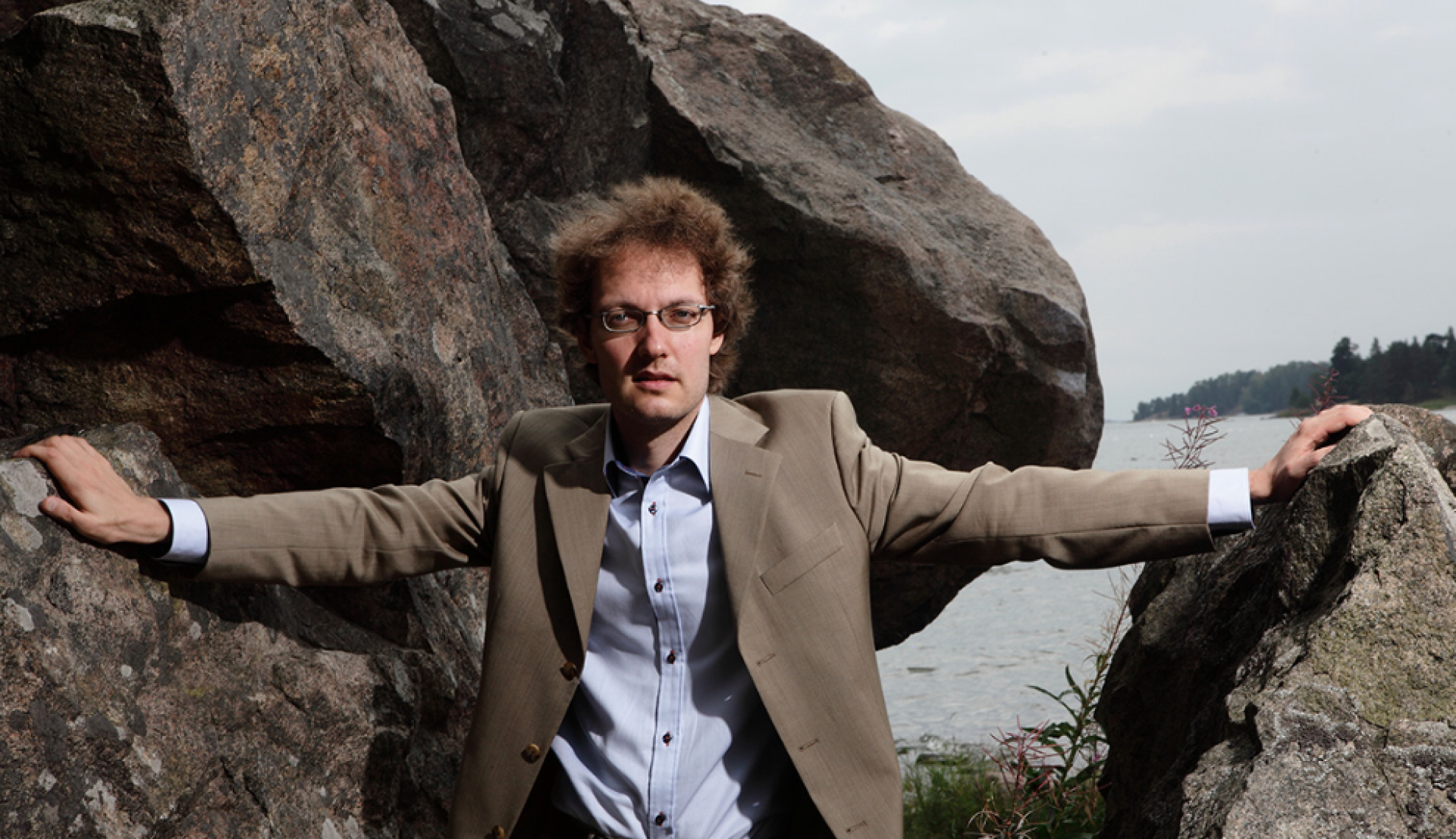
© Ville Paul Paasimaa
Helsinki Baroque Orchestra
Order tickets
May 2026 | ||||||
|---|---|---|---|---|---|---|
Mo | Tu | We | Th | Fr | Sa | Su |
One of the world’s best early music ensembles making its festival debut with an exploratory programme from the Czech archives
“They make a marvellously incisive sound, so thrilling,” wrote a critic for BBC Music Magazine in a review of a performance given by the Helsinki Baroque Orchestra. Another representative of the remarkable Finnish school of music, the group has been active on the scene for over a quarter of a century and, during this time, has evolved into one of the world’s finest ensembles dedicated to the historically informed interpretation of early music. Since 2003 they have been headed by Aapo Häkkinen, a laureate of the celebrated harpsichord competition in Bruges, who was taught by eminent teachers in Helsinki, Amsterdam and Paris, and whose mentor was the legendary organist, harpsichordist and conductor, Gustav Leonhardt. Accompanied by five outstanding singers and the Purcell Choir from Budapest, the orchestra is appearing at the Prague Spring for the first time to perform two masterful sacred works associated with the Czech Lands in the late 18th and early 19th centuries. The programme comprises the modern premiere of the oratorio La Purificazione di Maria Virgine (The Purification of the Virgin Mary) from 1807 by Antonio Casimir Cartellieri, second Kapellmeister at the court of Prince Joseph Franz Maximilian Lobkowitz, and Stabat Mater from 1805 by Jakub Jan Ryba, famous as the author of the Czech Christmas Mass.
“Bohemia under the last Holy Roman Emperors enjoyed a surfeit of cultural richness. The country of Dušek, Koželuh, Mozart, Vranický, Dusík and Rejcha was a melting pot of artistic excellence and innovation. The two large-scale sacred pieces on Marian themes programmed for this concert were both first performed in Bohemia during the first decade of the 19th century. It will be fascinating to hear such different approaches to church music,” says Aapo Häkkinen on his Prague Spring programme. Both Antonio Casimir Cartellieri (1772–1807) and Jakub Jan Ryba (1765–1815) were contemporaries of Ludwig van Beethoven (Cartellieri even played in the orchestra during the premiere of the Eroica Symphony and the Triple Concerto with Beethoven conducting). However, while Ryba led a humble existence as a schoolteacher in Rožmitál pod Třemšínem (Rosenthal), Cartellieri, who was born in the Polish city of Gdansk to an Italian tenor and German soprano, was engaged as a music teacher, violinist and later second Kapellmeister by Prince Lobkowitz. Cartellieri thus made a significant contribution to the musical environment at the Lobkowitz residences in Roudnice nad Labem and at Jezeří castle. “The oratorio La Purificazione di Maria Virgine is associated with Candlemas – or the Feast of the Purification of the Blessed Virgin – which commemorates the presentation of Jesus at the Temple by Mary and Joseph,” states Häkkinen, who is known for his fondness for performing unjustly neglected or forgotten works. “The most important music periodical of the 19th century, the Allgemeine musikalische Zeitung, reports rather begrudgingly on the premiere, which took place in Prague after Cartellieri’s death on 25 December 1807, lamenting the weak libretto, composed in an overly operatic style – the composer’s evident forte!,” says Häkkinen. “With his Italian background, Cartellieri was an innate vocal composer with an exceptional sense of sound colour, intuitive rhetorical facility, and a joyous imagination. The oratorio enjoyed popularity, and manuscript copies have been found in Vienna as well as in Florence,” he adds. It seems that the composer really was unusually gifted. He studied with Antonio Salieri, his stage works were performed at the Royal Opera in Berlin, and in Vienna in 1795 his Symphony No. 1 and the oratorio Gioas, Re di Giuda (Joash, King of Judah) appeared on the same programme together with the premiere of Beethoven’s Piano Concerto No. 2. Cartellieri was also responsible for one of the most important musical events in Bohemia at the turn of the 18th and 19th centuries – the production of Haydn’s oratorio The Creation in Roudnice nad Labem in 1799 and 1805; on the second occasion the work was even sung in Czech. It is indeed lamentable that he died at a mere thirty-four years of age.
Program and cast
Programme
Antonio Casimir Cartellieri: The Purification of the Virgin Mary (modern premiere)
Jakub Jan Ryba: Stabat Mater
Performers
Helsinki Baroque Orchestra
Aapo Häkkinen – conductor
Purcell Choir
György Vashegyi – chorusmaster
Lydia Teuscher – soprano
Marie Seidler – mezzo-soprano
Patrick Grahl – tenor
Tuomas Katajala – tenor
Cornelius Uhle – baritone
Rudolfinum
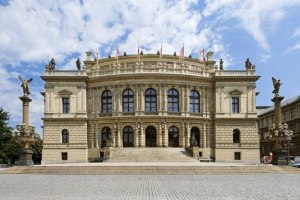
The Rudolfinum, one of the most noteworthy buildings in Prague, was built between 1876 and 1884 according to the designs of architects Josef Zítek and Josef Schulze. Originally intended as a multipurpose cultural building in Prague, the Rudolfinum was inagurated on February 7, 1885. It carried out its mission until 1919, when it was converted to the House of Commons of the Czechoslovak Republic. Concert activity was restored to the Rudolfinum during the German occupation, but full rehabilitation, particularly of the gallery, did not take place until 1992. After a general reconstruction by architect Karel Prager in 1992, the Rudolfinum became the home of the Czech Philharmonic and the Rudolfinum Gallery.
Dvorana – Ceremony Hall
The central space in the gallery portion of the Rudolfinum was designed by Josef Zítek and Josef Schulz as an entrance hall to the art gallery. After 1918, however, this space was converted into a parliamentary cafeteria, and after World War II it served as a gymnasium for the Prague Conservatory. At the end of the 1980s, Ceremony Hall was threatened with reconstruction – but plans to tear down the main staircase to make room for another concert hall did not go through, and the hall retained its original appearance. Of particular interest in Ceremony Hall are 25 empty spaces on its walls, which were originally intended to be filled in with frescos. The majority of the eminent Czech painters, however, boycotted the 1891 fresco competition in protest over the large number of German artists involved in the construction of the Rudolfinum.
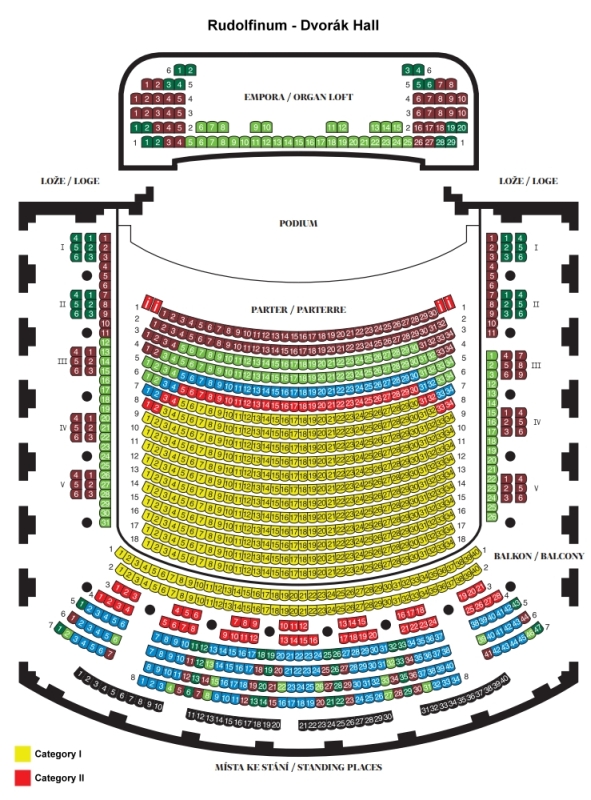
Dvořák Hall
The Czech Philharmonic took the stage in this world-famous concert hall in 1896, performing for its first-ever concert under the baton of Antonín Dvořák himself. The hall remained a space for concerts and performances until 1918, at which time it became a boardroom for the new parliament of the Czechoslovak Republic. The stage and the organ loft became a tribunal (garnished with a statue of President T.G. Masaryk), from which parliamentary leaders presided over proceedings. The hall's original character (and purpose) was restored
in 1940–1942 according to a project conceived by Antonín Engel and Bohumír Kozák, and it has remained in this form through to the present. In accordance with Josef Zítek and Josef Schulz's original proposal, the central visual element in the hall is an organ, which was made in Frankfurt, Germany. During the hall's stint as a parliamentary meeting place, the organ was housed in Brno. When it returned to the Rudolfinum in 1940, its register was extended. Dvořák Hall's final update took place in 1992 when the entire Rudolfinum building underwent reconstruction.
When travelling by public transport, get off at the Staroměstská metro station (Line A), tram stop (trams nos. 17, 18 and 53) or bus stop (no. 207).
Parking is available at the underground parking facility on Jan Palach Square. The facility is not part of the Rudolfinum premises.
Related events