
 EN
EN DE
DE IT
IT FR
FR ES
ES RU
RU JP
JP RO
RO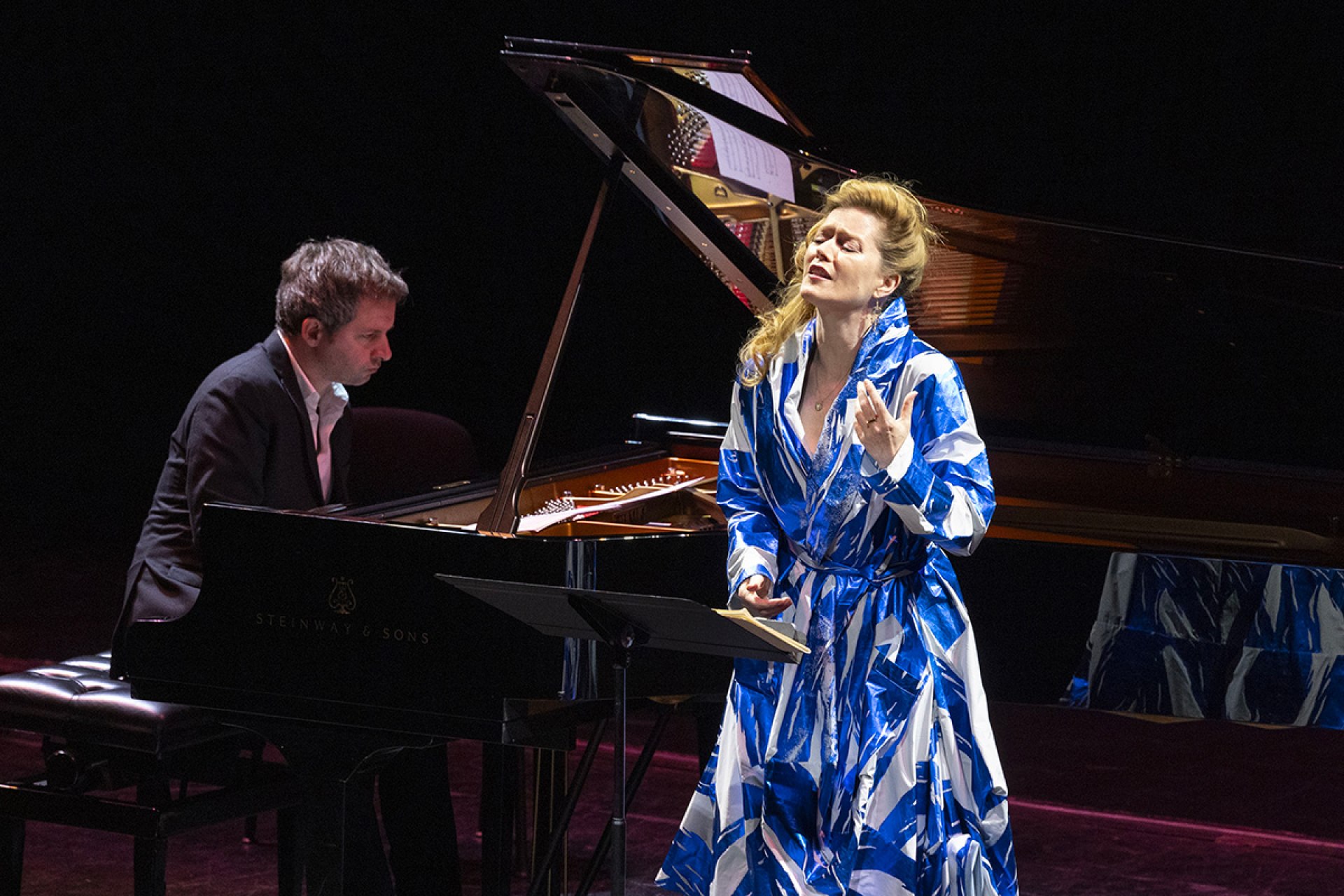
© Luciano Romano
Barbara Hannigan and Bertrand Chamayou
Order tickets
May 2026 | ||||||
|---|---|---|---|---|---|---|
Mo | Tu | We | Th | Fr | Sa | Su |
An evening during which the Grammy Award holder and Prague Spring Artist-in-Residence 2026 is reincarnated into pagan goddesses from the Finnish epic Kalevala in a work by John Zorn.
Artist-in-Residence of the Prague Spring 2026 Barbara Hannigan is one of the most original figures in the sphere of classical music. With her typical courage and determination she sings and also conducts, she inspires the finest contemporary composers in their endeavours, and she creates unique projects which go far beyond the customary concert experience. Born in Canada, she has performed the premieres of more than one hundred works. She collaborates with some of the world’s most distinguished conductors and orchestras, including the Berlin Philharmonic. She is Principal Guest Conductor of the Gothenburg Symphony Orchestra, she holds the positions of Associate Artist of the London Symphony Orchestra and the Première Artiste Invitée of the Orchestre Philharmonique de Radio France, and in the autumn of 2026 she will take up her post as Chief Conductor and Artistic Director of the Iceland Symphony Orchestra. Her exceptional artistic achievements are moreover reflected in a number of prestigious awards, among them a Grammy Award, the title Artist of the Year from Gramophone magazine, and the Polar Music Prize 2025, a Swedish international award established by music publisher and manager of ABBA Stig Anderson, which she won together with jazzman Herbie Hancock and the rock band Queen. Her Prague Spring residency will consist of four concerts.
The first concert will be a joint recital given by soprano Barbara Hannigan and superb French pianist Bertrand Chamayou. “After both European and North American tours I am thrilled to be able to introduce the Czech audience to this very spiritual programme,” says Barbara Hannigan. Prague concertgoers will thus finally be able to hear the utterly unique cycle Jumalattaret by American composer and multi-instrumentalist John Zorn (*1953). These songs, originating in 2012 as a musical setting of fragments from the Finnish national epic Kalevala, were long considered unsingable. Here the singer is reincarnated into Finnish pagan goddesses; “each measure is a minefield of intonation and technique” (The New York Times). This work, whose performance actually takes your breath away, is fascinating for the incredible vocal range it requires, from incredibly high top notes to throat-singing, ethereal humming, whispering, laughter and a voice that vibrates like birdsong. “It’s one of those pieces that was life-changing,” Barbara Hannigan declared of Jumalattaret. “You’ve got to tame the wild horse and get a saddle on it,” she said. “This piece took a lot for me to be able to do that.” Jumalattaret is such an astounding work that to hear it performed live by the Hannigan – Chamayou duo will undoubtedly be one of the highlights of the Prague Spring 2026. Moreover, not only will this be the first performance of Jumalattaret in the Czech Republic, but also the Prague Spring debut of Barbara Hannigan.
Program and cast
No intermission
Programme
Olivier Messiaen: Chants de terre et de ciel
Alexander Nikolayevich Scriabin: Poème-nocturne op. 61
Alexander Nikolayevich Scriabin: Vers la flamme op. 72
John Zorn: Jumalattaret
Performers
Barbara Hannigan – soprano
Bertrand Chamayou – piano
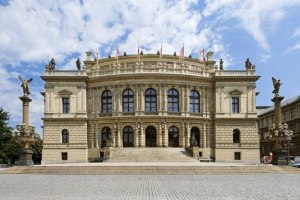
Rudolfinum
The Rudolfinum, one of the most noteworthy buildings in Prague, was built between 1876 and 1884 according to the designs of architects Josef Zítek and Josef Schulze. Originally intended as a multipurpose cultural building in Prague, the Rudolfinum was inagurated on February 7, 1885. It carried out its mission until 1919, when it was converted to the House of Commons of the Czechoslovak Republic. Concert activity was restored to the Rudolfinum during the German occupation, but full rehabilitation, particularly of the gallery, did not take place until 1992. After a general reconstruction by architect Karel Prager in 1992, the Rudolfinum became the home of the Czech Philharmonic and the Rudolfinum Gallery.
Dvorana – Ceremony Hall
The central space in the gallery portion of the Rudolfinum was designed by Josef Zítek and Josef Schulz as an entrance hall to the art gallery. After 1918, however, this space was converted into a parliamentary cafeteria, and after World War II it served as a gymnasium for the Prague Conservatory. At the end of the 1980s, Ceremony Hall was threatened with reconstruction – but plans to tear down the main staircase to make room for another concert hall did not go through, and the hall retained its original appearance. Of particular interest in Ceremony Hall are 25 empty spaces on its walls, which were originally intended to be filled in with frescos. The majority of the eminent Czech painters, however, boycotted the 1891 fresco competition in protest over the large number of German artists involved in the construction of the Rudolfinum.
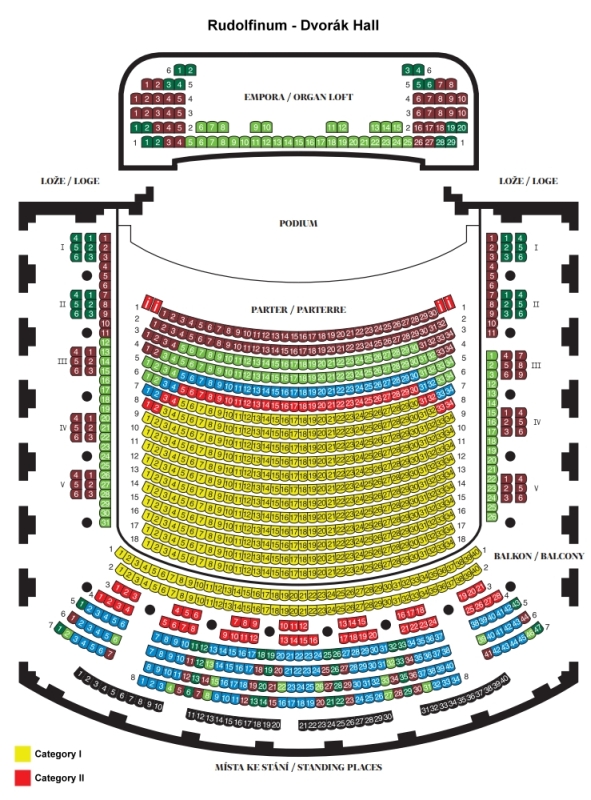
Dvořák Hall
The Czech Philharmonic took the stage in this world-famous concert hall in 1896, performing for its first-ever concert under the baton of Antonín Dvořák himself. The hall remained a space for concerts and performances until 1918, at which time it became a boardroom for the new parliament of the Czechoslovak Republic. The stage and the organ loft became a tribunal (garnished with a statue of President T.G. Masaryk), from which parliamentary leaders presided over proceedings. The hall's original character (and purpose) was restored
in 1940–1942 according to a project conceived by Antonín Engel and Bohumír Kozák, and it has remained in this form through to the present. In accordance with Josef Zítek and Josef Schulz's original proposal, the central visual element in the hall is an organ, which was made in Frankfurt, Germany. During the hall's stint as a parliamentary meeting place, the organ was housed in Brno. When it returned to the Rudolfinum in 1940, its register was extended. Dvořák Hall's final update took place in 1992 when the entire Rudolfinum building underwent reconstruction.
When travelling by public transport, get off at the Staroměstská metro station (Line A), tram stop (trams nos. 17, 18 and 53) or bus stop (no. 207).
Parking is available at the underground parking facility on Jan Palach Square. The facility is not part of the Rudolfinum premises.
Related events